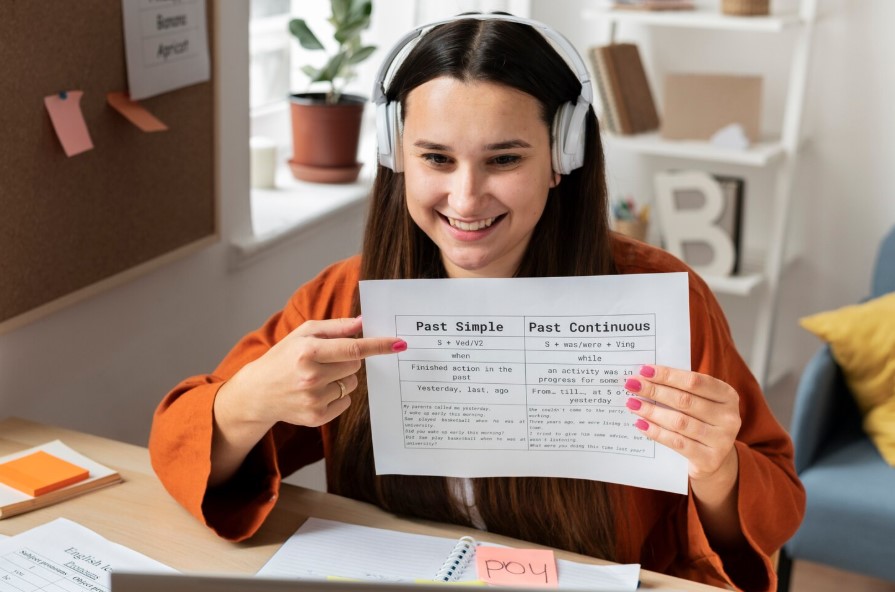
Let’s Speak About Speaking 🤷🏻♀️
If there’s one part of the IELTS that makes English learners nervous, it’s the Speaking test. It’s short. It’s unpredictable. It’s you, your ideas, and the examiner; with no time to think too long or start over. And yet, speaking is the most trainable skill if you know how to practise the right way.
At Test & Score, we’ve watched thousands of learners start with hesitation and end up speaking clearly and confidently.
So, How to Master IELTS Speaking Through Online Practice?❌ Not through random chats or memorising answers. High scorers succeed because they practise IELTS Speaking effectively: ✔️ Following focused steps and practising online with feedback. But how exactly? |
Step 1: Orient Yourself Before Any Speaking Practice 🧩
Before jumping into IELTS Speaking cue cards or simulations, take a pause to understand where you are and where you need to go.
Your first step in IELTS speaking practice online should be orientation: understanding your current strengths, weaknesses, and time availability.
💭 Start with a quick diagnostic Speaking test on Test & Scorediagnostic Speaking test on Test & Score.
You’ll instantly receive an estimated band score and a breakdown of your performance across the four IELTS Speaking criteria:
- Fluency and Coherence
- Lexical Resource
- Grammar Range and Accuracy
- Pronunciation
Then, reflect on these key questions:
- What is my target band score?
- Which part of the IELTS Speaking practice test feels hardest — Part 1, Part 2, or Part 3?
- How many days per week can I realistically commit to speaking practice?
- How will I track improvement — by AI feedback, recorded sessions, or mentor reviews?
💭 Write down your answers. They form the foundation of your online Speaking practice plan.
Step 2: Dive Into Online Speaking Practice Tests & Simulations 💻
Realistic, online IELTS Speaking
practice changes everything. Because simulations recreate the real IELTS experience: the format, timing, and pressure.
It’s where you discover your habits — do you pause too much, repeat phrases, or lose ideas mid-sentence?
Each online Speaking practice should:
walk you through one of these parts or combined (full test):
- Part 1 – familiar questions (“What do you do?” “Where do you live?”)
- Part 2 – long turn with a cue card (2 minutes)
- Part 3 – abstract discussion to test reasoning.
By repeating these Speaking simulations under real conditions, you start speaking more automatically and that’s exactly what fluency is.
💭 Try rotating topics: technology, education, environment, art, lifestyle. Each new theme builds flexibility, helping you respond even when the question surprises you.
Online Speaking Practice Has Never Been EasierOn Test & Score: 👌🏻 Find hundreds of online IELTS Speaking simulations, covering various topic types, and each response is recorded automatically. ✔️ You get a complete playback, along with instant AI-powered feedback and 9-band model answers. |
Step 3: Record and Reflect on Feedback 🔄
Here’s a secret most learners ignore: your recordings are worth more than your practice minutes.
Why?
Because hearing yourself speak is the fastest way to spot what you never realised you were doing, such as repeating fillers or hesitating mid-sentence.
Generally, if you’re doing online self-practice in IELTS Speaking, mimic this loop:
Record yourself.
Listen back and note issues (hesitations, unclear phrases).
Practise again focusing only on that one weakness.
💭 The feedback doesn’t stop there. When you receive the band-score estimate after each test, track your improvement daily/weekly.
Step 4: Practise Consistently to Improve Your Speaking 📈
Consistency is the hardest part of IELTS preparation. Many learners begin with enthusiasm, but motivation fades after a few days of solo practice.
The truth is simple: you don’t need to study more, only regularly.
Essential tips to make your online IELTS Speaking practice sustainable:
✔️ Set Micro-Goals
Instead of saying, “I’ll practise speaking for two hours,” say, “I’ll complete one Part 3 test today.”
💭 Smaller goals are easier to start and finish, and that keeps your momentum.
✔️ Create a Weekly Rhythm
A fixed routine works better than unplanned
practice. Define what you will practise and on which days.
Example:
- Saturday: Practise Part 1 for 1 hour
- Sunday: Practise Part 2 with focused review for 2 hours
- Monday:
Practise Part 3 for 30 minutes
💭 Use the provided schedule template in our full guide to plan and commit to a complete IELTS course.
[The Best Plan & Platform to Start Your Full IELTS Course]
✔️ Use Tracking Tools
This method is especially useful if you want to see measurable progress.
Our Test & Score Dashboard tracks every Speaking practice test, provides instant feedback, and shows your estimated band score.
This keeps your self-practice focused and guided, which is especially important for IELTS Speaking. Check it
Step 5: Build English Fluency, Not Just Speaking Practice 💬
Many learners rely on memorised IELTS Speaking templates. But memorisation alone isn’t enough.
Fluency comes from training your mind to think and respond in English. How?
Here are the essential habits to build alongside your regular Speaking practice.
✔️ Think in English Daily
Narrate simple actions or thoughts. Such as: “I’m preparing tea,” “I’m reviewing yesterday’s feedback.”
This trains faster response time during the test.
✔️ Model Native Speech
If you can speak with native speakers, do it. If not, use short podcast or YouTube clips and imitate the speaker’s rhythm and tone.
This strengthens pronunciation, stress, and confidence.
✔️ Learn Vocabulary by Theme
Choose one topic each week (e.g., Education). Learn a few useful phrases and practise applying them throughout the day.
This strengthens your spontaneity and expression.
✔️ Use Better Connectors
Move beyond basic links. Try natural transitions like “on top of that,” “what’s interesting is,” or “having said that.”
This makes your speech more cohesive.
Apply The Five Steps of Online Speaking Practice 🗣️
By now, you can see that practising IELTS Speaking online is possible, but it requires a clear path and consistent effort.
Each of these five steps builds on the other:
You set your environment, so your brain feels ready.
You use real IELTS Speaking simulations to get comfortable with pressure.
You record and analyse to catch blind spots.
You train fluency and natural speech through topic-based practice.
You stay consistent and measure growth.
Your First IELTS Speaking Practice Starts Now
These tips won’t work unless you have one platform with the right tools to focus your IELTS-Speaking preparation and avoid scattered effort.
We don’t want you to just “take another mock test.” That's why we've created an exclusive offer for you!
All You Need for IELTS SpeakingAll features are available for FREE on Test & Score:(Limited time offer) ✅ Hundreds of online IELTS Speaking practice tests ✅ Full test library for all four skills ✅ AI-powered score & feedback ✅ Progress dashboard to measure your growth → Claim your offer |
Unlock The IELTS Exam
Listening | Reading | Writing | Speaking | Practice Basics | About IELTS
Related Articles
“ 7 Hidden IELTS Speaking Tricks – Boost Your Band Score | Test & Score”
“IELTS Speaking Test Online – Free Practice with AI Feedback | Test & Score”
“IELTS Speaking Part 1 Topics – Common Questions and Vocabulary | Test & Score”
“IELTS Speaking Part 3 Topics – Practice with Answers and Feedback | Test & Score”
“IELTS Speaking Part 2 Cue Card – Tips and Talking Topics | Test & Score”
“IELTS Speaking Test Topics – Answer Confidently with the Sandwich Technique | Test & Score”
Explore Official IELTS Resources
Unlock The IELTS Exam
Listening | Reading | Writing | Speaking | Practice Basics | About IELTS
Related Articles
“ 7 Hidden IELTS Speaking Tricks – Boost Your Band Score | Test & Score”
“IELTS Speaking Test Online – Free Practice with AI Feedback | Test & Score”
“IELTS Speaking Part 1 Topics – Common Questions and Vocabulary | Test & Score”
“IELTS Speaking Part 3 Topics – Practice with Answers and Feedback | Test & Score”
“IELTS Speaking Part 2 Cue Card – Tips and Talking Topics | Test & Score”
“IELTS Speaking Test Topics – Answer Confidently with the Sandwich Technique | Test & Score”